


Media Reports
Asian Financial Summit Forum and Asian Financial Think Tank Annual Forum (2021) Viewpoint Part IV
On December 2, Asian Financial Summit Forum and Asian Financial Think Tank Annual Forum (2021) was successfully held in Beijing. The theme of the forum is “Deepen Regional Financial Cooperation to Boost Economic Recovery”.
The forum has a panel discussion on “Cooperation and Development of Sustainable Finance”, which invited Mr. Masamichi Obara, Deputy Chairman, MUFG Bank (China), Ltd., Mr. Xu Yuchang, Chairman & President, China Economic Information Service Co., Ltd., Mr. Hubertus Väth, Managing Director, Frankfurt Main Finance, Mr. Dong Ximiao, Chief Research Fellow of Merchants Union Consumer Finance Co., Ltd & Visiting Research Fellow of Financial Research Institute of Fudan University, Ms. Ashley Zhang, Chief Representative of Asia Pacific Regional Office, Institute of International Finance, Mr. Zheng Yongqiang, Deputy General Manager and Chief Investment Officer, Mitsui Sumitomo Insurance (China) Co., Ltd., and Mr. Baur Bektemirov, Chief Economist and Member of the Management Board, Astana International Financial Centre Authority to discuss problems, experiences and lessons in the development of sustainable finance and to share thoughts on its future prospects.
Mr. Masamichi Obara, Deputy Chairman of MUFG Bank (China), Ltd., introduced that in 2020, Green Bond Guideline was revised and Green Loan and Sustainable Linked Loan Guideline was issued in Japan. In 2021, Transition Finance Basic Guideline was also issued which covers a broader range of transactions and the Corporate Governance Code was revised. To support the cause of carbon neutrality, many sessions were arranged in Japanese financial industry to help each employee to understand the importance and necessity of ESG and carbon neutrality. At the same time, financial markets were developed and improved by adopting new evaluation methods and disclosure rules of carbon neutrality in line with an international trend. The market volume of Sustainable Finance has grown rapidly in recent years. The year 2021 till November recorded a total volume of Green Bonds, Green Loans, Sustainability Bonds and Sustainability Linked Loans as 2.6 trillion Japanese Yen (146 billion RMB), and the compound annual growth rate from 2017 to 2021 was over 66.5%. In addition, Japan will continue to discuss and study improving the quality and quantity of corporate information disclosure, leveraging the investment and financing support of market mechanisms and financial institutions, and managing climate change risk, to promote sustainable socio-economic development. He also emphasized that financial institutions should correctly understand directions our customers and their industries are moving to, evaluate their real situation fairly, and efficiently provide finance services.
Mr. Xu Yuchang, Chairman and President of China Economic Information Service Co., Ltd, shared three points about information services. Firstly, financial cooperation and economic development cannot be achieved without authoritative, accurate, objective and impartial information services, and great importance must be attached to effective information services. Secondly, the China Economic Information Service of Xinhua News Agency has the responsibility and ability to provide effective information services. It is committed to providing reliable and effective information services to financial institutions and has operated several economic information service platforms. Thirdly, the CEIS hopes to step up cooperation in financial information services through the AFCA. In the future, it will further leverage its advantages in economic and financial information services to help more member institutions keep abreast of developments, accurately size up the situation, effectively arrange investments, steadily prevent and control risks, and promote win-win cooperation among all parties through the AFCA.
Mr. Hubertus Väth, Managing Director of Frankfurt Main Finance, stated that the COP26 took stock of the current climate change situation, which can be regarded as both triumph and disaster. During the conference, the draft report of the EU-China common ground taxonomy was published and the formation of the International Sustainability Standards Board (ISSB) was announced, developing an internationally recognized set of standards in language and information use. Both China and the EU have announced ambitious climate targets and have speeded up their efforts to promote green finance with important progress and innovative measures. He believes that there is a great potential for cooperation and exchanges in developing the carbon trading market in the future.
Mr. Dong Ximiao, Chief Research Fellow of Merchants Union Consumer Finance Co., Ltd and Visiting Research Fellow of Financial Research Institute of Fudan University, reviewed the development of the concept of sustainable finance and pointed out that sustainable finance has become the current trend of the global financial industry. Observing and studying sustainable finance can regard it as a development concept, an institutional arrangement or an action plan. He stressed that sustainable finance is based on the sustainable use and rational allocation of financial resources, which is an organic balance between meeting the needs of economic development and the rational utilization of financial resources. To make sustained efforts to promote sustainable financial cooperation and development, he made three suggestions. First, top-level design should be used to lead and coordinate policy implementation, which should be achieved in a top-down manner. Secondly, there should be universal green financial standards on the basis of a green industry catalogue. Thirdly, the financial sector should practice sustainable finance concepts and actions actively.
Ms. Ashley Zhang, Chief Representative of Asia Pacific Regional Office of Institute of International Finance, gave a brief introduction of IIF’s work on sustainable finance. She said that there is evidence shows that climate change has increasing adverse effects on economic activities and supply chains and severe chain reaction on the economy. China's peak carbon neutrality target of 30/60 fully demonstrates its sense of responsibility as a major country and it has the potential to boost employment in its quest to reach carbon neutrality. ESG investment in the Asia-Pacific region has been growing exponentially. For now, China accounts for only about 10% of total regional ESG assets under management, highlighting the tremendous potential for growth. China has also been a global leader in green bonds, with continued innovation in areas such as carbon neutrality bonds and green certificates of deposit. She believed that the next decade could be the decade of the carbon market. Further expansion of compliance markets is likely, particularly in North America, Latin America, and Asia, and net-zero or carbon neutral commitments will likely become the norm for the world’s largest companies. She stressed that to address climate change, financial institutions should not only provide support for global green financing, but also pay attention to climate change risk prevention. The institutions are advised to conduct stress tests against climate change risk and assess the stability of related infrastructure.
Mr. Zheng Yongqiang, Deputy General Manager and Chief Investment Officer of Mitsui Sumitomo Insurance (China) Co., Ltd, said that international experience can contribute to the development of sustainable finance in China. He presented in turn the practical experience of sustainable finance offered by the EU, the Japanese experience of green finance development, the strategic objectives of financial companies, the extensive participation of social organizations, the seven strategies for global sustainable investment, and the prospects for cooperation between China and Europe on sustainable development. He suggested that China's sustainable finance has made a number of progress, such as developing inclusive finance to help fight poverty, promoting green finance globally as mainstream, and introducing and advocating sustainable finance concepts, etc.. However, there are also problems including imperfect top-level design, different rules and standards, imperfect market mechanisms and insufficient product innovation. Thus, he made five suggestions for the improvement of sustainable finance in China. First, developing sustainable financial in China can draw on the experience of green finance development; second, the top-down approach can be used to improve the top-level design of sustainable finance; third, uniform standards of sustainable financial disclosure can rely on a mandatory disclosure approach; fourth, innovation in sustainable finance-related products should be encouraged with sustainable development as its purpose; and fifth, fintech can support to promote the digitization of sustainable finance.
Mr. Baur Bektemirov, Chief Economist and Member of the Management Board of Astana International Financial Centre Authority, pointed out that we need to add “impact or coordinate regionally” to the motto “think globally, act locally”, for the cause of reducing the carbon emission and battling global warming. Further cross-border infrastructure connectivity, seamless transactions, firm implementation of free trade arrangements, and the employment of e-commerce or automation are required from all countries to ensure the continued prosperity of trade in the post-pandemic era. He also shared the progress and contribution of the Astana International Financial Centre to accelerate sustainable investment. It has established partnerships with many participants in the sustainable finance ecosystem, responded to the BRI Green Investment Principles, facilitated carbon finance dialogue, etc. He noted the growing importance of digitalization supporting global economic recovery and sustainable growth. Greater integration of digital technology and the real economy will power the transformation and upgrading of traditional industries and the development of new industries, new businesses, and new models, which can be new drivers of economic growth. Digitalization of financial services should be made full use to promote global connectivity, digital transformation, and cooperation alongside BRI.
Participants from financial regulators, AFCA member institutions, non-member financial institutions and the media from over 30 countries, including China, Japan, Korea, Singapore, the United States, the United Kingdom, Germany and Italy attended the forum online.
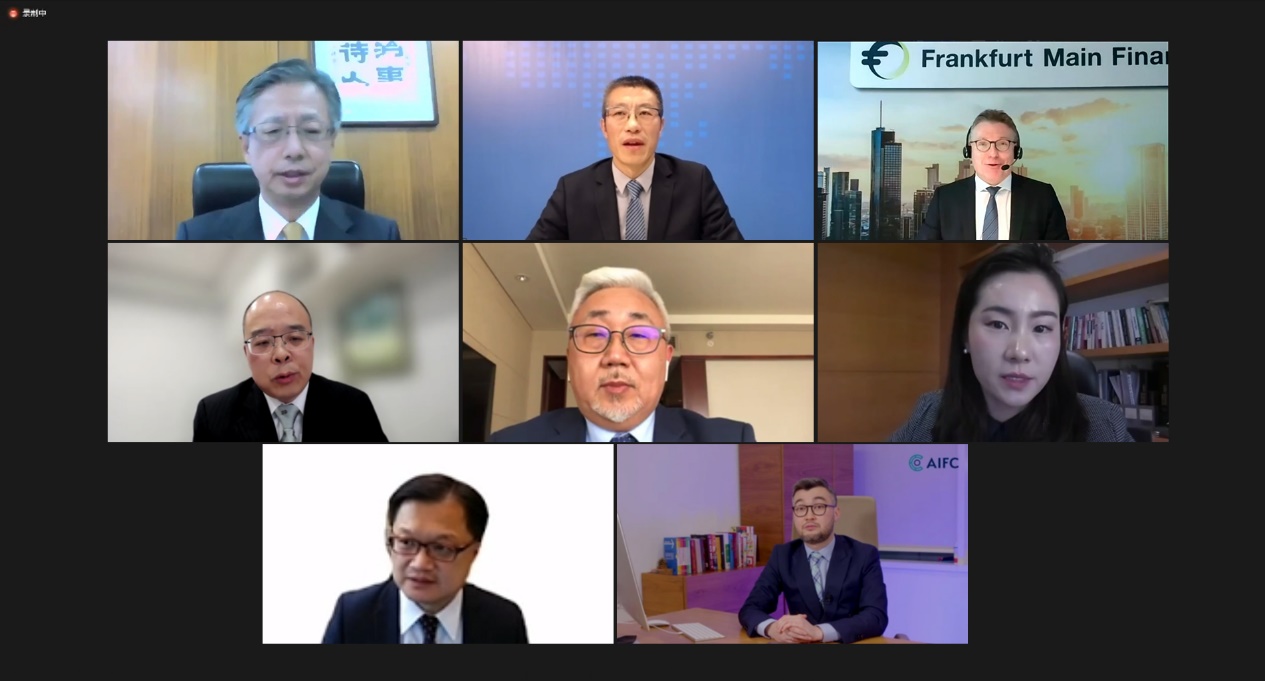
Panelists